

The private credit market in India is still at a nascent stage, representing about 0.6% of India’s GDP. However, this does not diminish its prominent role in India’s financing and investment landscape. Many players are entering the private credit space due to the rising demand for this asset class in India’s fast-growing economy, driven by financing gap for mid-sized companies that are underserved by traditional banks and capital markets. Further, the strengthening of institutional frameworks in India following the implementation of the Insolvency and Bankruptcy Code (IBC) has given greater confidence to all the stakeholders.
Across the emerging markets, India has become one of the most active markets for private credit deals. The private credit deployment stood at US$9 billion in the 2025-first half, representing 53% rise from 2024-first half and ~200% from 2024-second half. Notably, global funds remained the dominant players in the market (68%) while domestic funds constituted the rest (32%), focusing on mid-market corporate lending (Ernst & Young, Aug 2025).
The deal flow for private credit funds has been broadly diversified across sectors. Typically, sectors witnessing increasing M&A activity and extraordinarily high growth seek credit solutions from private credit funds. The infrastructural platforms across renewable energy, transportation, and high-growth corporate segments like electronics manufacturing and logistics are contributing to a large share of the deal flow.
The investment climate in the private credit market is also gaining momentum. The rising financialization of Indian savings and growing awareness among investors about the merits of private credit compared to other investment avenues are contributing to its continued growth. The private credit strategies, which mostly operate in Category II AIFs (for instance, Performing Credit), and also in Category III AIFs (for instance, semi-liquid funds), are evolving over time to suit investors’ appetite for higher risk-adjusted returns and better flexibility during periods of market uncertainties.
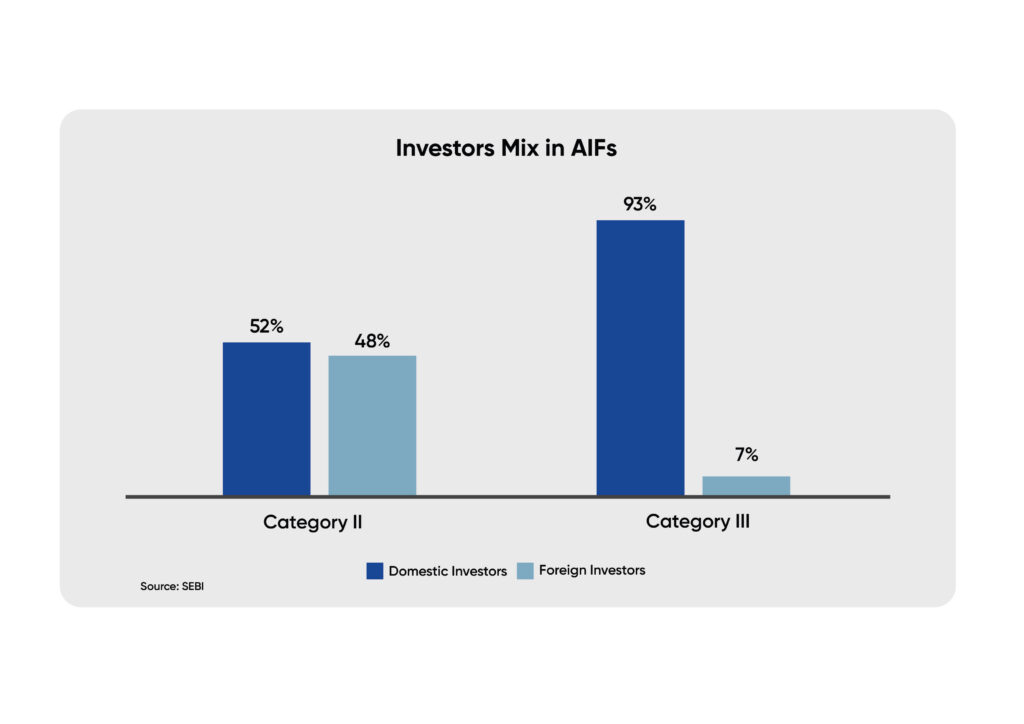
The majority of appetite in India’s private credit market is coming from domestic investors (in Category II and III AIFs), who are mainly high net worth individuals, corporates, family offices, and institutions. Notably, development finance institutions, sovereign funds, and some pension funds have been actively investing as well. The Category II space has witnessed a higher appetite from foreign investors compared to the Category III space, as shown below.
Apart from market uncertainty, the domestic and foreign investors are attracted to the market for diversification, inflation hedge, and predictable returns, which typically range between 12% to 20% on a pre-tax basis and are significantly higher than many traditional avenues of debt investments. As per a report by Julius Bär, large family offices in India are allocating 15%-25% of their portfolios in alternative investments, of which 25%-30% goes to private credit vehicles.
An expanding economy that can accommodate a large number of deals at lucrative pricing makes yields attractive for investors. AIFs are able to charge a premium for lending arrangements for the incremental risk borne by them due to borrowers’ creditworthiness, the quality of collateral, the likelihood of recovery in case of default, and their expertise to offer bespoke credit solutions.
Further, the regulatory climate acted as an enabler of growth. The Finance Act 2023 provided the long-awaited level playing field to all debt asset managers of various pooled investment vehicles (MFs, PMS, AIFs). The Finance Bill 2025, shifting the tax treatment on income from transfer of securities in Category II funds from business income to capital gains, also boosted investors’ interest in the segment.
Disclaimer: The information provided in this article is for general informational purposes only and is not an investment, financial, legal or tax advice. While every effort has been made to ensure the accuracy and reliability of the content, the author or publisher does not guarantee the completeness, accuracy, or timeliness of the information. Readers are advised to verify any information before making decisions based on it. The opinions expressed are solely those of the author and do not necessarily reflect the views or opinions of any organization or entity mentioned