

Central Bank Policies: Tightening to Easing
The year 2025 is marked by a transition from monetary policy tightening (2022-23) to easing, barring decisions that were influenced by local economic data. The trend is expected to continue in early 2026 as concerns for inflation abate and economic growth slows down.
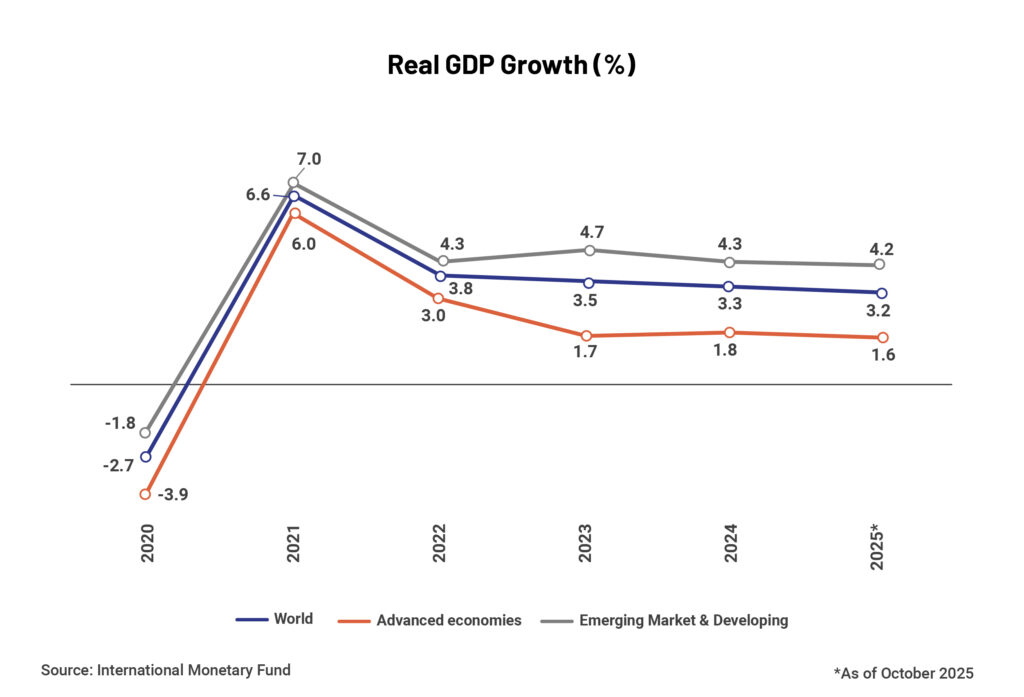
The Reserve Bank of India concluded 2025 with four rate cuts that cumulatively stood at 125 basis points (bps) since the beginning of the year. In the December meeting, the central bank, in a unanimous vote, reduced the repo rate by 25 bps to 5.25%, the lowest level since July 2022. The US Federal Reserve also reduced its key interest rates by 25 bps to 3.5%–3.75% in its December 2025 meeting, which is its lowest level since 2022.
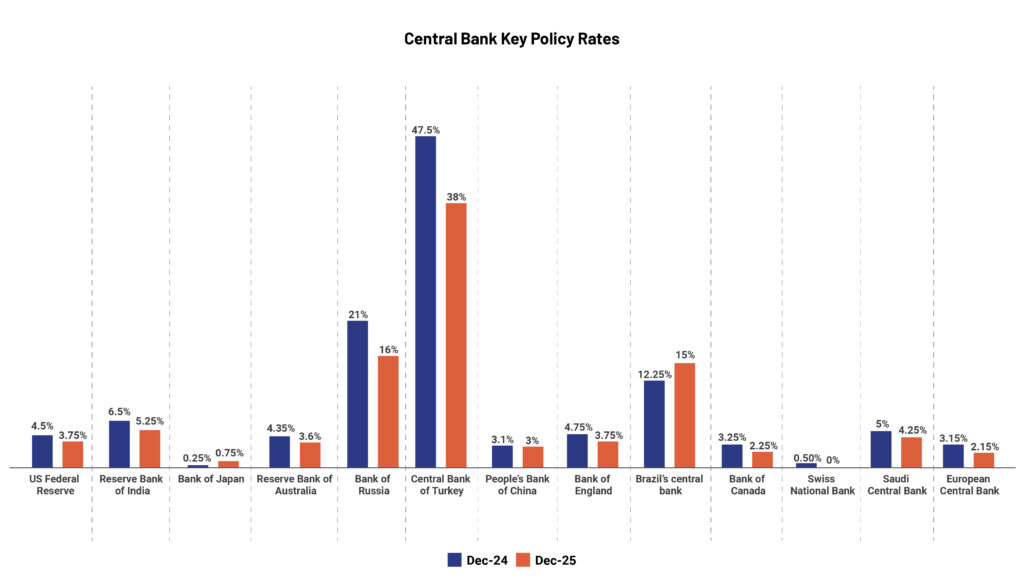
India’s retail inflation, measured as a change in the Consumer Price Index (CPI), eased throughout the year, barring few upticks, falling below the medium-term target of 4% and thereafter below the lower end of the RBI tolerance range in the second half of the year. It declined 4.31% in January to multi-year low of 0.25% in October before increasing a tad to 0.71% in November. It remained below the RBI’s medium-term target of 4% for the tenth consecutive month and below the lower end of RBI’s tolerance range of 2%-6% for the third consecutive month. With this, the average retail inflation during the year (January-November) stood at 2.4%.
Food inflation, the largest component of the CPI, has been the key contributor to the continuous fall in retail inflation, giving the central bank enough comfort for repo rate adjustments. Food prices have progressively softened and remained in deflation in the second half of the year. Within the food basket, the subdued prices of vegetables as well as pulses, cereals, milk, and eggs, throughout the year have contributed to the decline in food inflation.
In its December Monetary Policy Committee Meeting, RBI cut the FY26 inflation forecast to 2% from the earlier projection of 2.6%. Inflation is likely to remain muted in the upcoming quarter, supported by favourable foodgrain production, pass-through of GST rate rationalisation, low crude oil prices keeping fuel inflation in check among other factors.
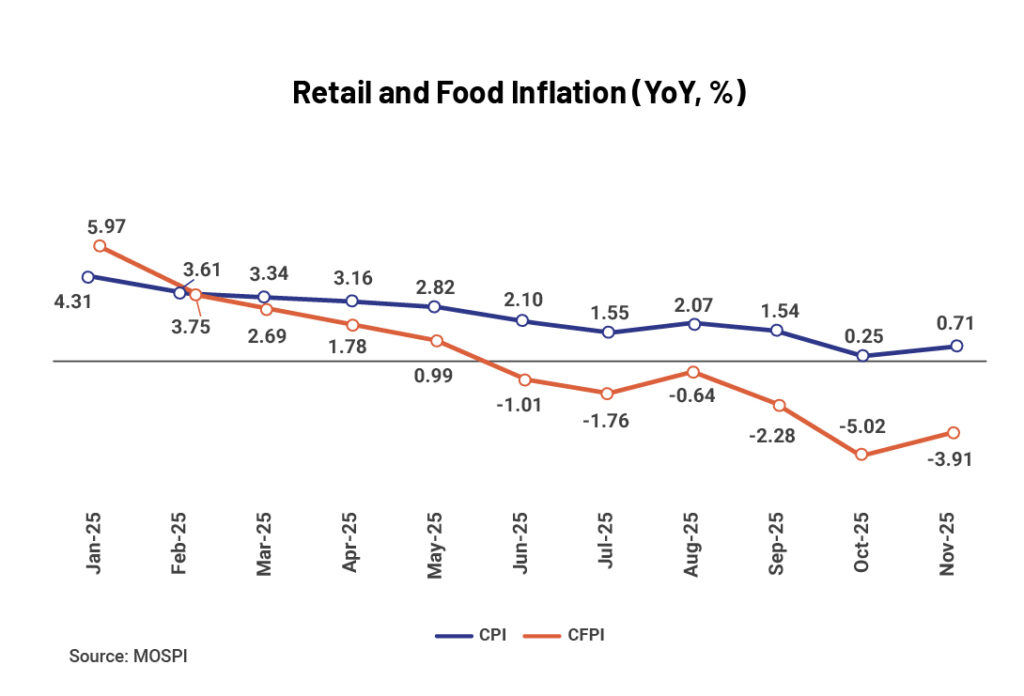
The wholesale inflation is likely to move to positive territory in early 2026, albeit at low levels, due to fading base effects, uptick in global commodity prices, and depreciation of Indian rupee against the USD.
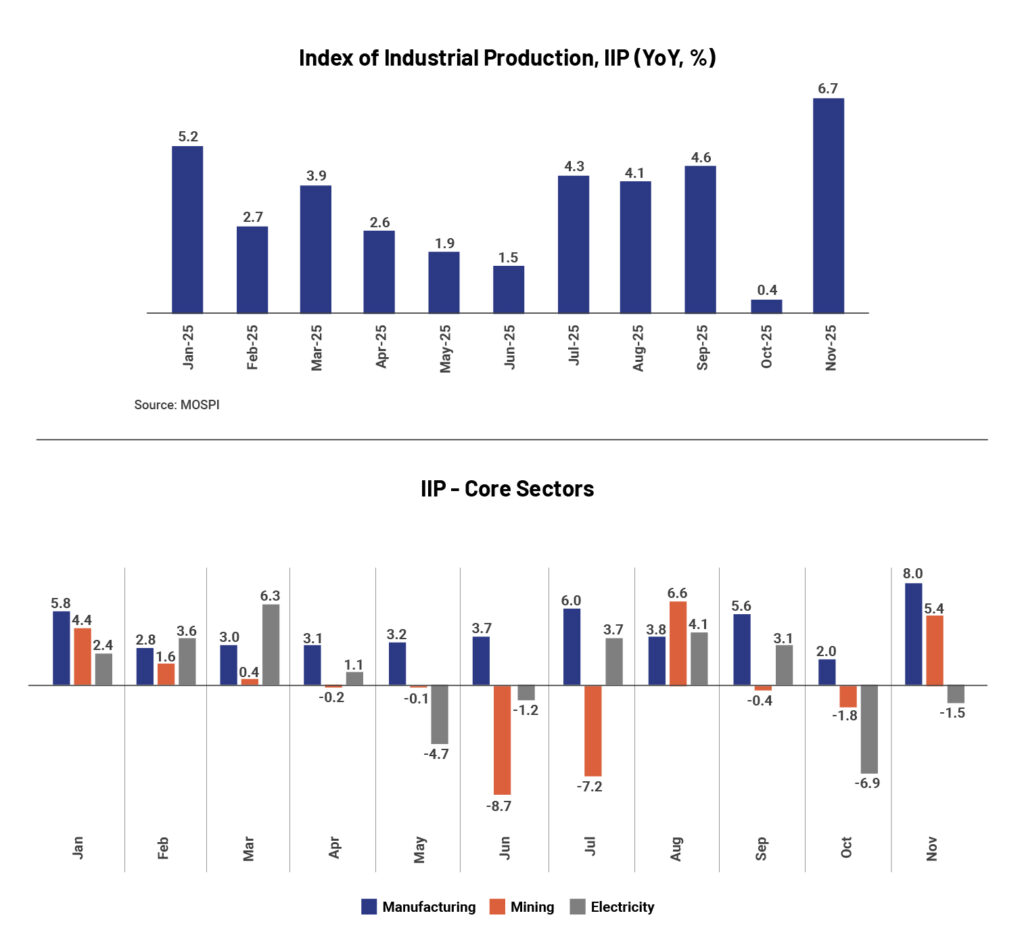
India’s industrial output, which is measured by the Index of Industrial Production (IIP), registered an uneven growth in 2025 with a mid-year moderation, experiencing the lowest drop (14-month low) in October and a sharp rebound in November driven by sharp uptick in manufacturing and consumer goods output.
Manufacturing sector, the largest component in the IIP basket, sustained the growth momentum in 2025 compared to mining and electricity. The growth in mining and electricity sector was moderately volatile throughout the year. The average IIP growth for 2025 (January-November) stood at 3.4%. The IIP growth is expected to ease to 3-5% in early 2026 as the base effect fades and the restocking benefit from GST rationalization wanes, although, the underlying momentum for manufacturing output will remain intact based on government policies and the focus on infrastructure spending.
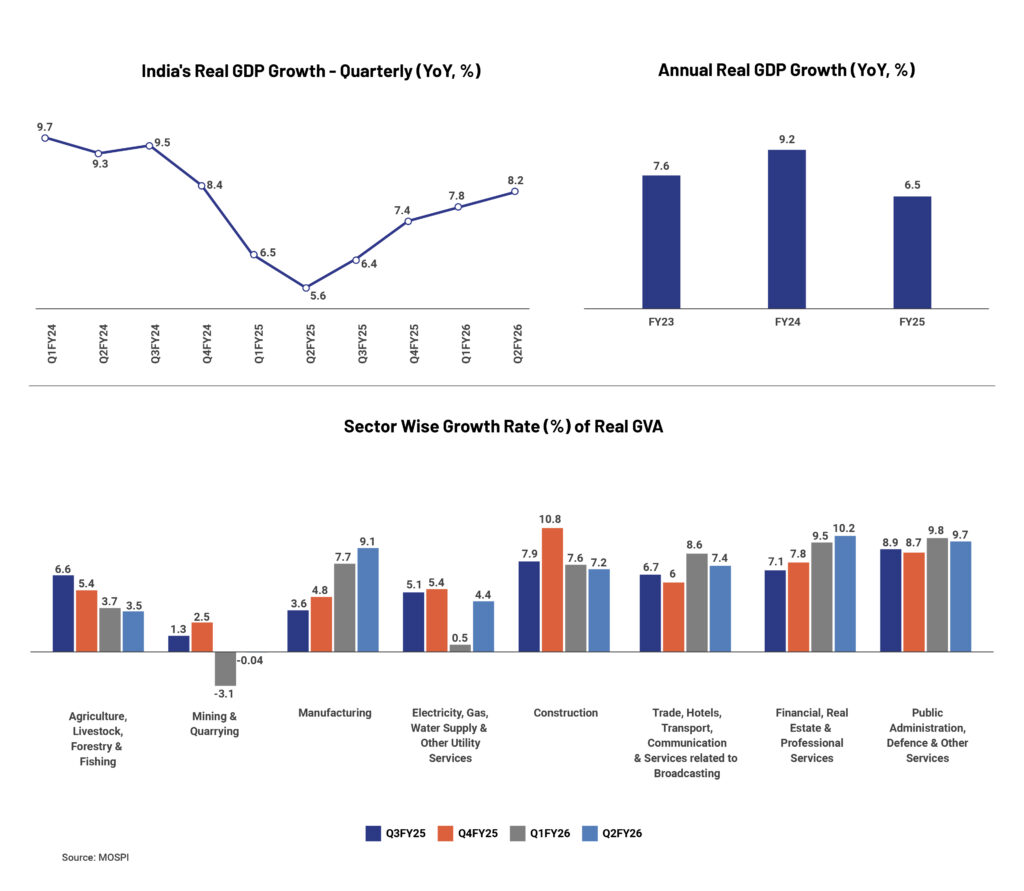
The real GDP growth peaked to the six-quarter high YoY growth of 8.2% in Q2 FY26, implying an 8% YoY growth for H1 FY26, thereby solidifying India’s position as the world’s fastest-growing major economy. Robust manufacturing and services sectors, with major contributions from financial services/real estate services, accelerating investment, and targeted government spending fueled the growth in Indian economy. The real spending growth was positive due to benign inflation and policy measures.
The momentum led economists to revise FY26 growth forecasts upward to 7.4% (on average), which is higher than RBI’s recent forecasts of 7.3% and beat last year’s growth of 6.5%. A resilience economy and tight financial conditions were the major catalysts for growth despite global and tariff-related uncertainties.
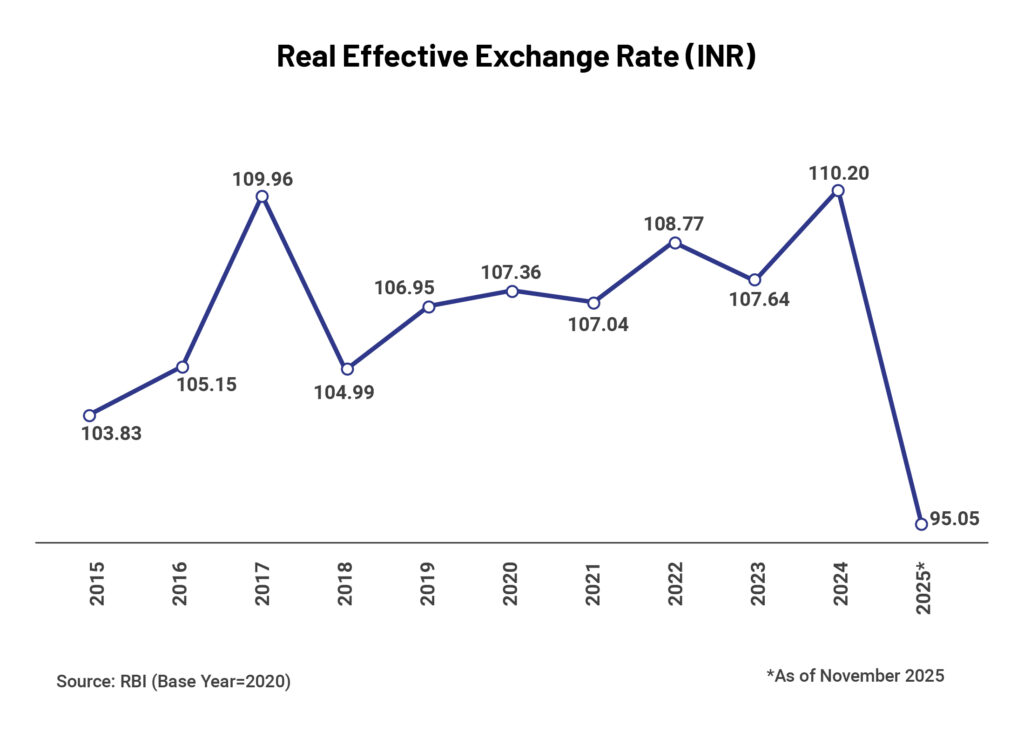
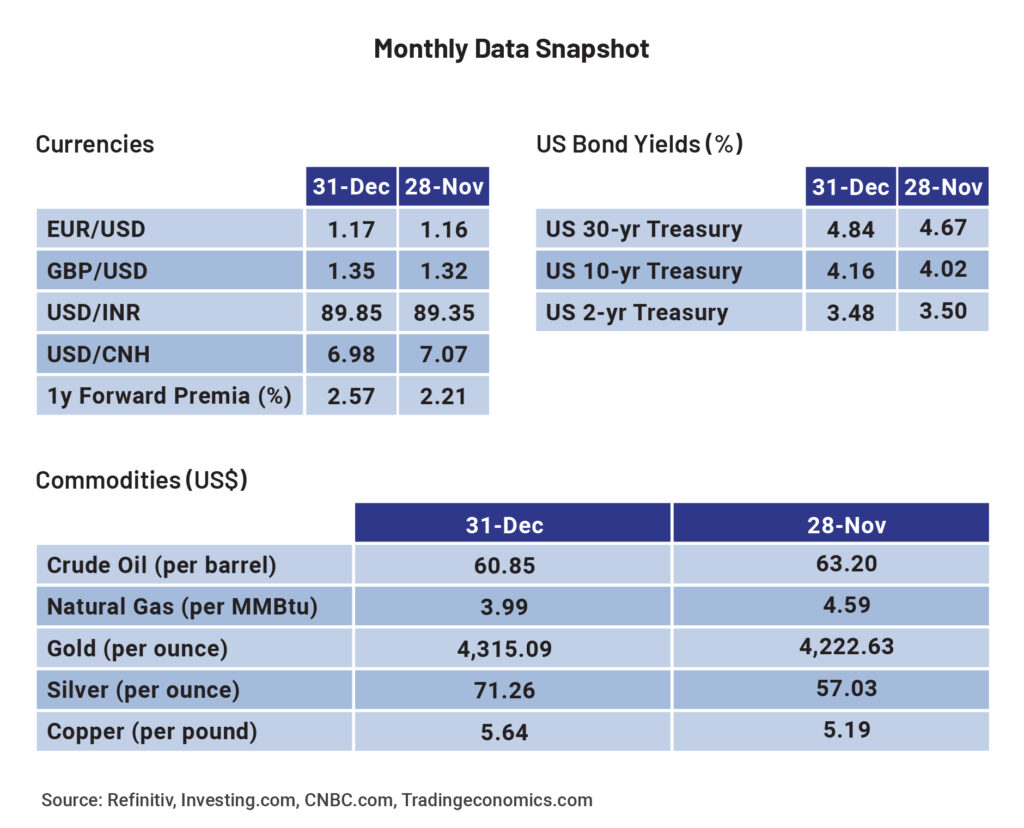
The domestic currency showed a negative bias throughout the year due to continuous foreign investor outflows and trade tensions due to US tariffs. The currency ended the year with a ~5% fall against the greenback, touching record lows of around INR 90-91 by the year-end. It also performed poorly against the Asian peers like the Chinese Yuan, Indonesian Rupiah, and Philippine Peso, among others.
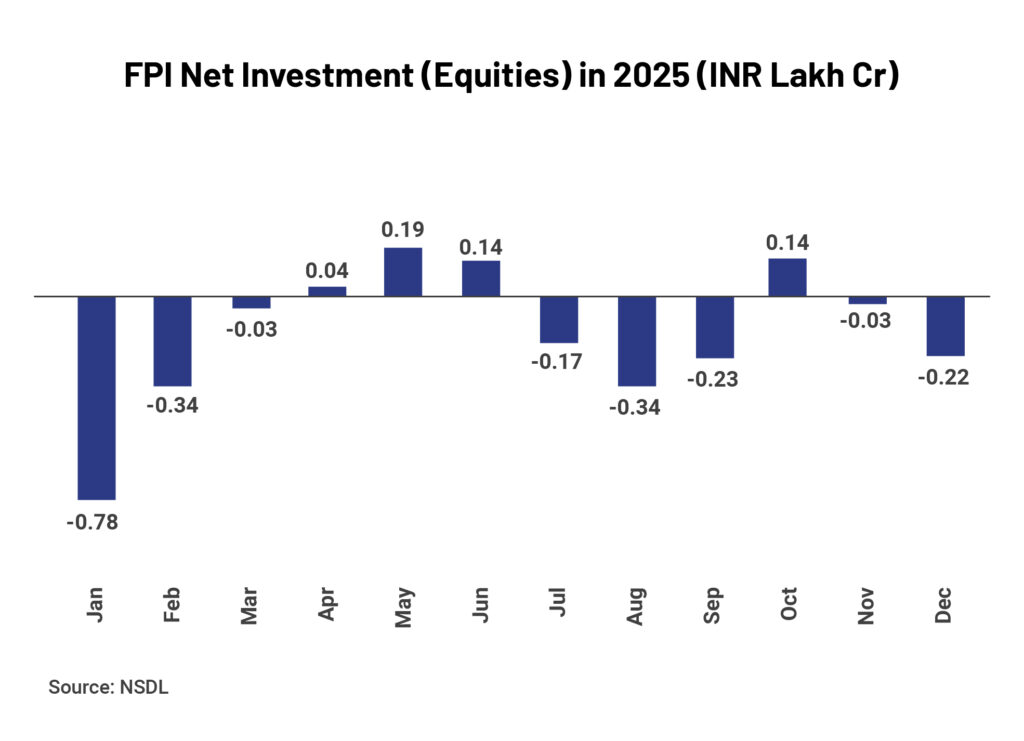
The foreign portfolio investors pulled money out of Indian equities at a record ~INR 1.6 lakh crore (~USD 18 billion) in 2025. As per market forecasts (Nomura, S&P Global, and others), the domestic currency is expected to hit INR 92 against USD by the end of March 2026.
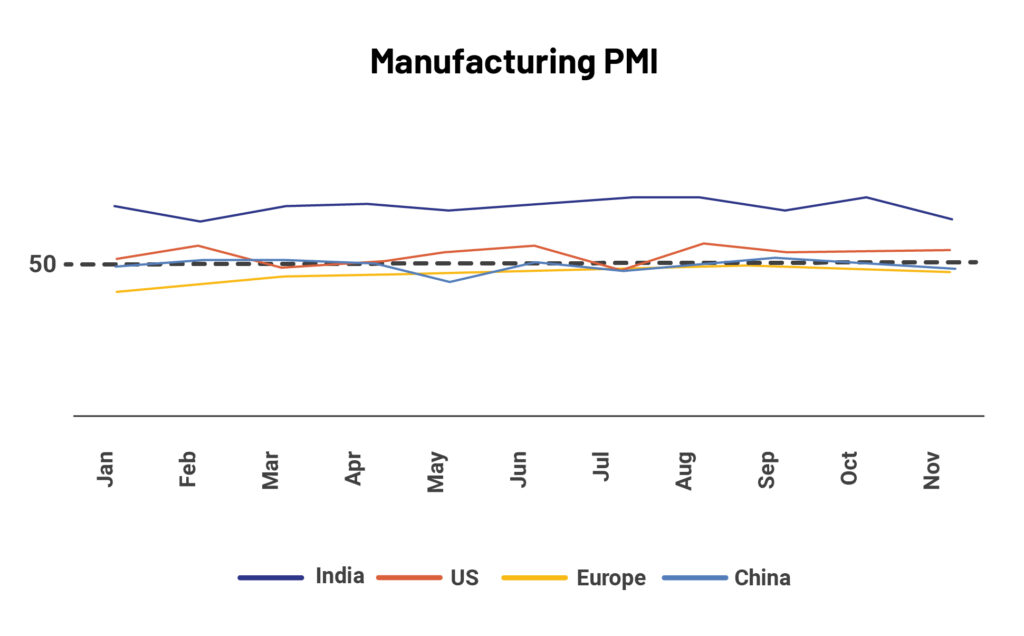
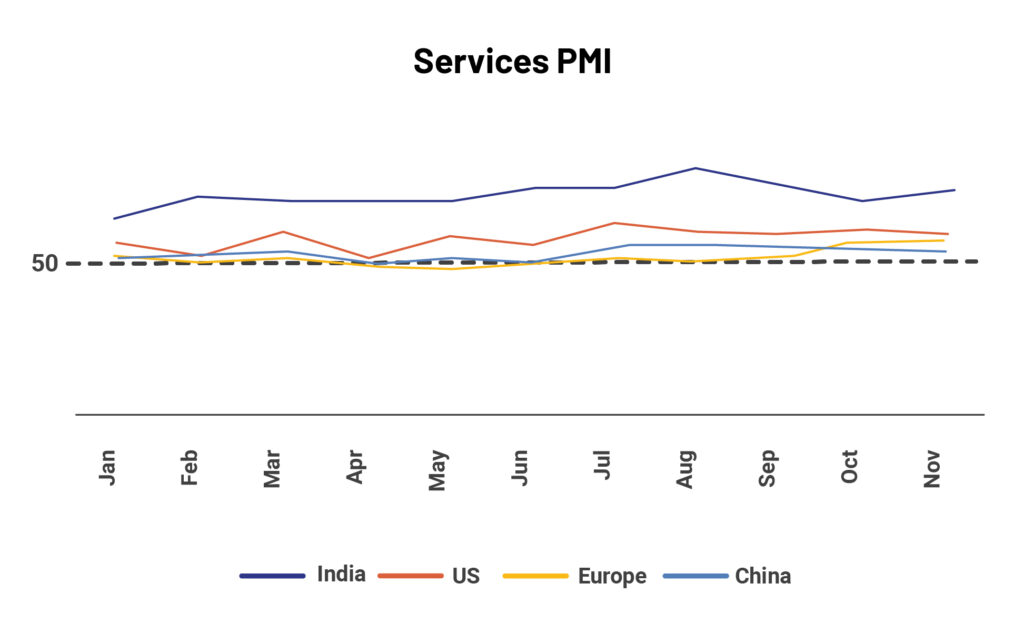
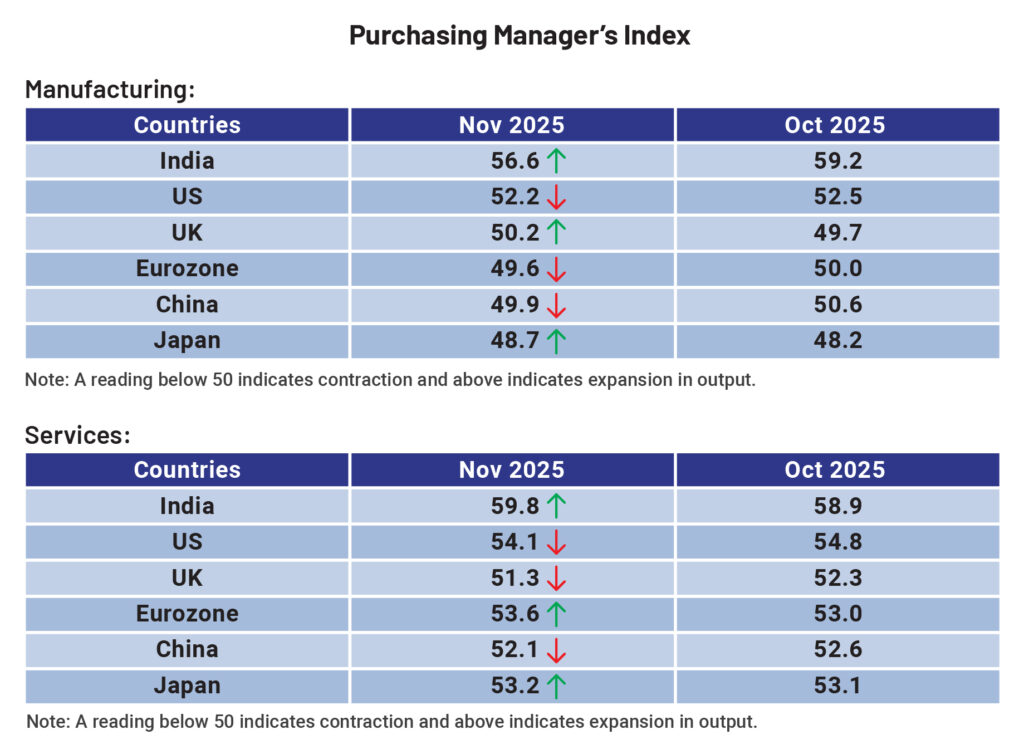
The Indian Manufacturing PMI remained above the breakeven mark of 50 throughout the year, driven by robust domestic demand, strong new orders, and increased production. The US and China Manufacturing PMI have mostly stayed in the expansionary zone, except for a few months in the year, due to strong domestic demand. The European manufacturing PMI stayed mostly in the contraction zone, mainly due to weakening demand, especially exports.
Disclaimer: The information provided in this article is for general informational purposes only and is not an investment, financial, legal or tax advice. While every effort has been made to ensure the accuracy and reliability of the content, the author or publisher does not guarantee the completeness, accuracy, or timeliness of the information. Readers are advised to verify any information before making decisions based on it. The opinions expressed are solely those of the author and do not necessarily reflect the views or opinions of any organization or entity mentioned.