

Executive Summary
The escalation in geopolitical tension continues to dominate the global market, with a US military strike in Venezuela followed by the attack on Iran. Heightened Middle East conflict saw crude spiking sharply as supply disruptions, including the closure of the Strait of Hormuz (a significant global supply passageway), and global asset prices took a beating. On tariffs, President Trump’s unilateral and uncertain moves continue, starting with pressure on Europe on the Greenland issue despite agreed deals, before backing out and levying a uniform 15% tariff after the Supreme Court struck down Trump’s earlier tariff move. All of this cumulatively is leading to trust issues with the US, which in turn will impact the US exceptionalism theme. Europe’s defence spending has already started increasing. However, as far as the US asset selloff is concerned, the moves haven’t been dramatic yet. Elsewhere, turbulence on Japan’s political front subsided after a resounding mandate, with yields and currency taking a breather from the pre-election selloff, after positive comments around fiscal discipline from government officials.
On the domestic front, sentiment remained wobbly early in the year, as FPIs continued to pull out from the Indian market, putting pressure on currency and risk assets. Two trade deals, later in the year, with the EU and US, provided the much-needed relief, and markets saw a significant rally with currency gaining over a percent on a single trading day. Budget announced on 1st Feb, provided policy continuity with focus on capex and continued fiscal consolidation with debt/gdp target of 50±1% by FY31. The fiscal math remained realistic and credible; however, bond markets did not find any relief from the selloff entailed so far in the year, as borrowing remains high to finance the deficit target of 4.3% for FY27.
On the monetary policy side, RBI unanimously kept the rates unchanged, while maintaining the stance at neutral, and ensuring sufficient liquidity in the banking system for effective monetary policy transmission. Inflation and growth projections were revised marginally higher. Unless any key data surprises, RBI looks like it is on an extended pause while focusing on policy transmission. The recent geopolitical tensions in the Middle East have once again put pressure on the currency as crude prices spiked sharply. The crisis will be closely watched, as crude prices have a significant bearing on the overall Indian economy.
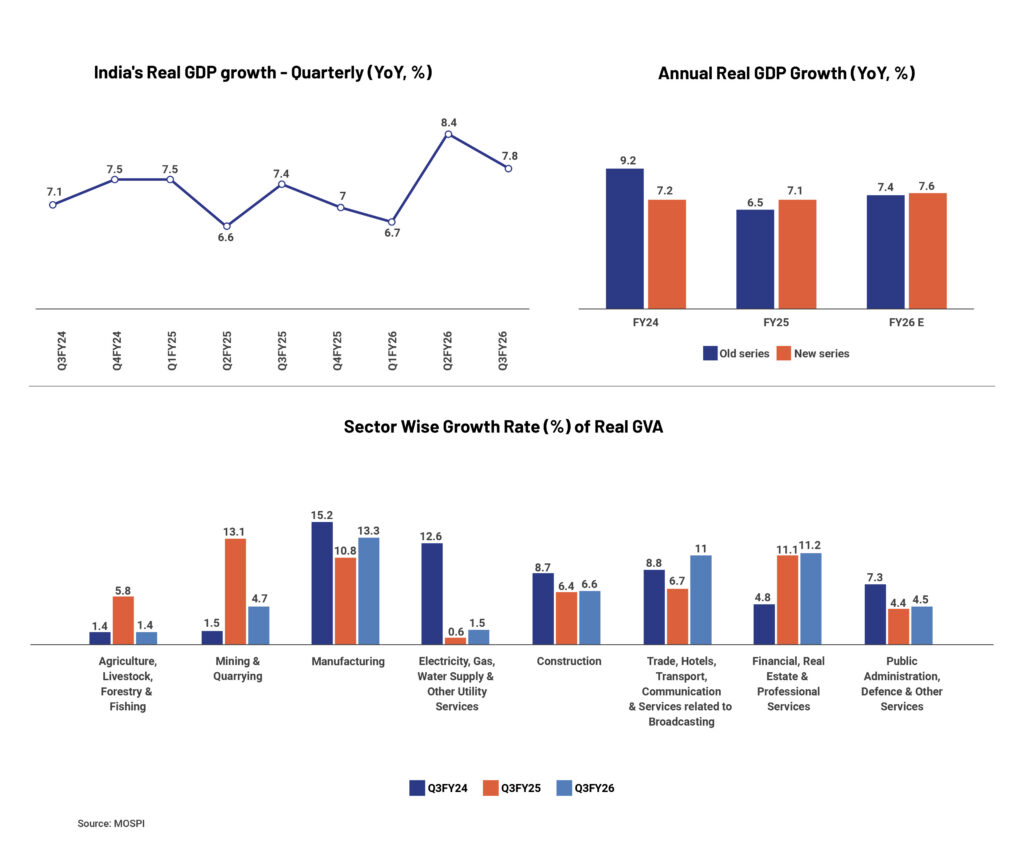
India’s economic growth weakens under new series of estimates, FY26 projections go up
India’s real GDP growth slowed to 7.8% YoY in Q3FY26 from a 6-quarter high of 8.4% in Q2FY26 due to deceleration in government spending (4.7% vs. 6.6% in Q2 FY26) and private investment (7.8% vs. 8.4% a quarter ago). Despite the easing, India continued to remain the fastest growing major economy in the world. The Q3FY26 print is the first that has been released by Ministry of Statistics and Programme Implementation (MoSPI) under the new GDP series with 2022-23 as the base year, which is devised to better reflect India’s evolving economic structure and to capture the capture the contribution of emerging sectors and consumption patterns as well as to align with globally best practices.
Under the new series, the GDP growth for FY26 and FY27 have been estimated at 7.6% and 7-7.4%, respectively, compared to earlier projections of 7.4% and 6.8-7.2%, respectively, under the old series. The growth estimate for Q1FY26 has been lowered to 6.7% from 7.8% earlier and for Q2FY26 revised upwards to 8.4% from 8.2% earlier.
As per the sectoral distribution of GDP, growth in secondary (industry) sector (10.1% in Q3FY26) surpassed the growth in primary (agriculture) (1.7%) and tertiary (services) sectors (9.5%). The growth in secondary sector is driven by manufacturing, which continues to be the key contributor to GDP growth over the past three fiscal years. Given the government focus on increasing manufacturing output in Indian soil, the trend is likely to continue.
On the expenditure side, the contribution of private consumption remained strong, which stood at roughly 55% to 62% of GDP in FY26, expanding by 8.7% in Q3FY26 compared to 8% in the previous quarter. The growth in government expenditure moderated to 4.7% in Q3FY26 from 6.6% in Q2FY26. The growth in private investment or the gross fixed capital formation also decelerated to 7.8% from 8.4% in the prior quarter. Net exports contributed negatively to the GDP, as exports rose 5.6% while imports grew 8.6% in January.
Going forward, domestic demand along with ongoing acceleration in services and manufacturing sector expect to drive economic growth in the medium term. Being a consumption driven economy, the rationalisation of GST rates are expected to continue impacting the economic growth positively. Moreover, the government’s fiscal consolidation roadmap and bilateral trade agreements with major economies are expected to play a key role in supporting the growth momentum.
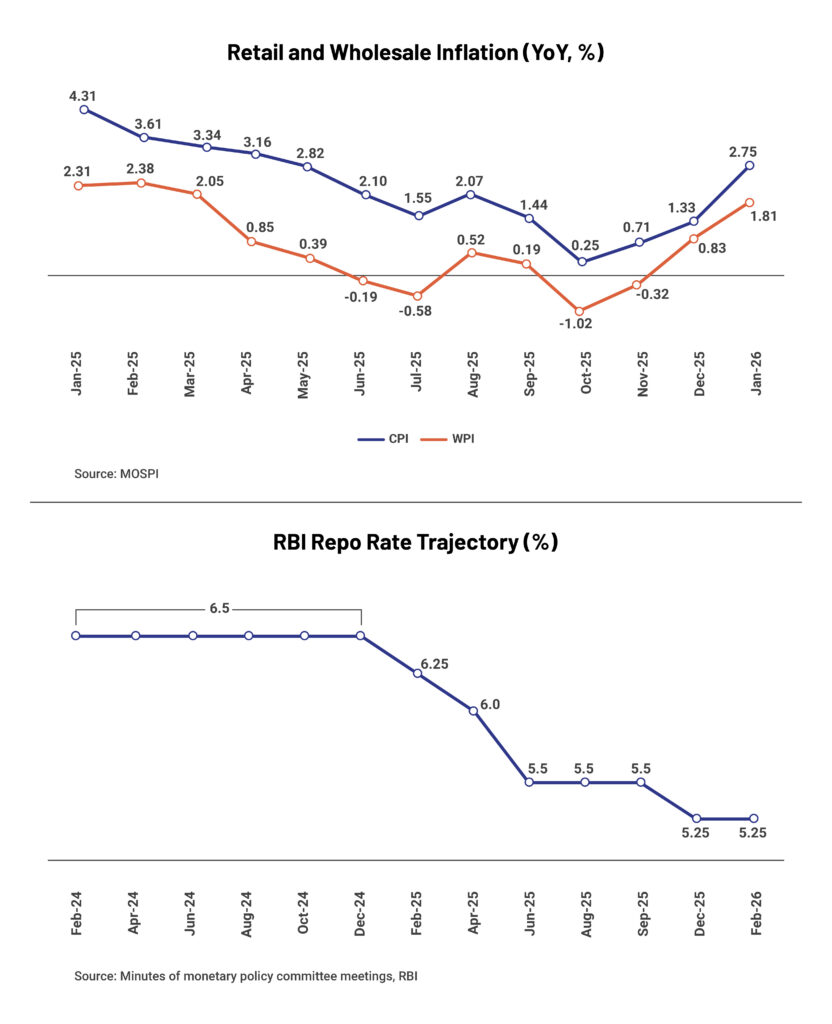
India’s retail inflation, which is measured by the change in the Consumer Price Index (CPI), increased to 2.75% YoY in January 2026, under the new series with 2024 as the base year, from 1.33% in December 2025 (old series with 2012 as the base year). With this, inflation rose from the sub 2% range since September 2025 to the RBI’s tolerance range of 2%-6%. The new series reflects updated consumption patterns, expanded item coverages and more granular inflation data.
The food inflation moved to positive territory at 2.31% YoY in January after staying in the negative since July 2025. This can be largely attributed to an increase in prices of Meat-fresh, chilled, or frozen (8.52% in January vs. 5.27% in December), fruits and nuts (7.87% vs 6.66%) and fish and other seafood items (6.74% vs 4.94%). The deflation in vegetables, the second largest in the food basket as per new series, softened in January (5.3% vs 17.76%) due to lower inflation in garlic, onion, potato, and peas.
Core inflation, which excludes volatile prices of food and energy, moderated to 3.4% YoY in January (new series) from 28-month high of 4.6% in December (old series). This can be attributed to decrease in inflation for housing segment, health, information and communications, and restaurant and accommodation services. Food inflation is expected to spike in the near term primarily due to low base effect.
Wholesale inflation rose to a 10-month high of 1.81% YoY in January 2026 from 0.83% in the previous. This uptick is driven by higher inflation for food & non-food articles, as well as basic metals, minerals, and textiles.
Inflation for manufacturing products, which carry the highest weight in the IIP basket, accelerated to 10-month high of 2.86% YoY in January mainly due to increase in prices of basic metals (5.98% YoY in January vs. -0.07% in December). Inflation in primary articles rose to a 11-month high of 2.21% YoY in January largely driven by a sharp rebound in vegetables inflation (6.78% vs.-3.5%), and increase in prices of eggs, meat and fish (3.66% vs. 1.14%), and non-food articles (7.58% vs. 2.95%). Fuel and power segment remained in the deflationary zone for the 10th consecutive month. While the decrease in prices of precious metals could push WPI upwards in the near term, the ongoing geopolitical tensions could impact global oil prices leading to upside risks to inflation.
The Reserve Bank of India (RBI) kept its policy rate unchanged at 5.25% in the February monetary policy meeting citing positive inflation and growth outlook amid evolving economic conditions. The policy rates could potentially trend lower assuming benign inflation. However, the impact of geopolitical issues could adversely impact the market prices to some extent.
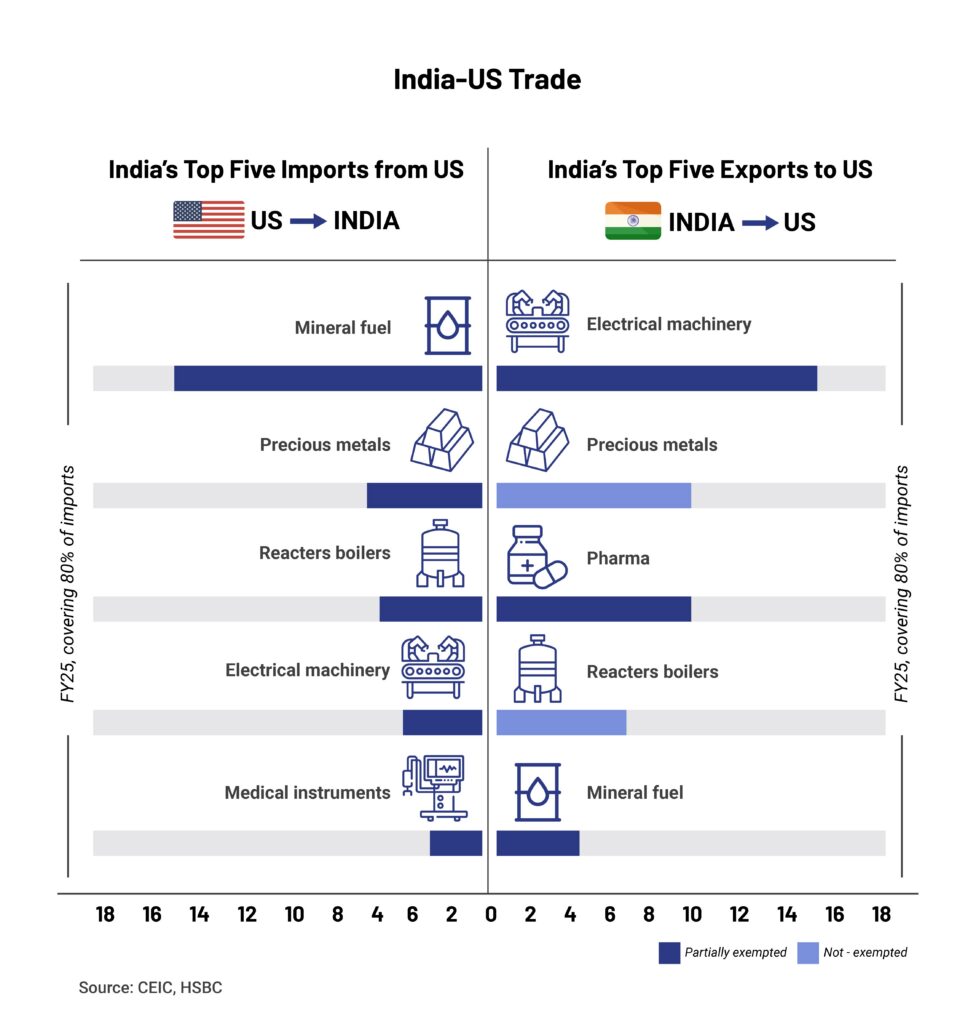
The long-awaited deal finally materialized with two major nations releasing a joint statement outlining the framework of the proposed Bilateral Trade Agreement. Although it’s an interim agreement pending further details, the deal came close on the heels of free trade agreements with the EU and the UK, putting Indian exports at the centre stage of growth.
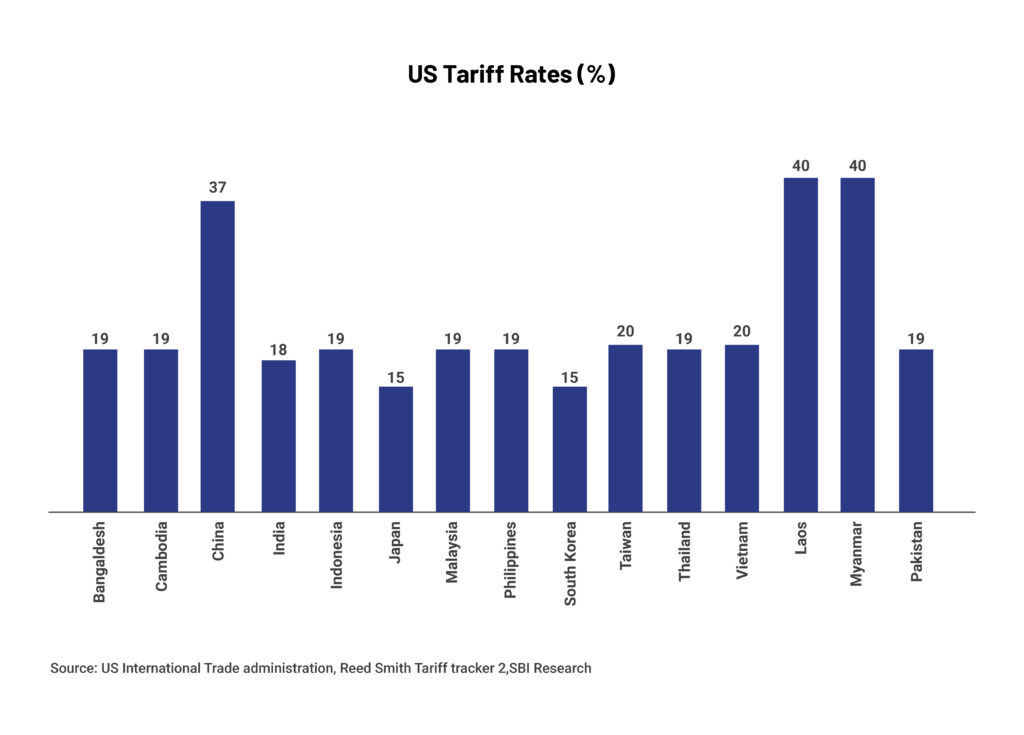
As per the interim framework, the US has agreed to lower the 50% tariff on India’s goods to 18%. This would be effective in two ways – India’s “reciprocal tariffs” will be set at 18% instead of 25%, effective immediately, and the additional 25% tariff related to the import of Russian oil will be removed, as India has reportedly agreed to stop buying Russian oil. The tariff structure will cover sectors such as textiles and apparel, leather and footwear, plastics and rubber, organic chemicals, home décor, artisanal products, and some machinery. It will also remove tariffs on specific aircraft and aircraft parts imported from India. With the revised rate, India now has one of the lowest tariffs among key Asian economies.
US growth slows down led by private consumption and govt. spending
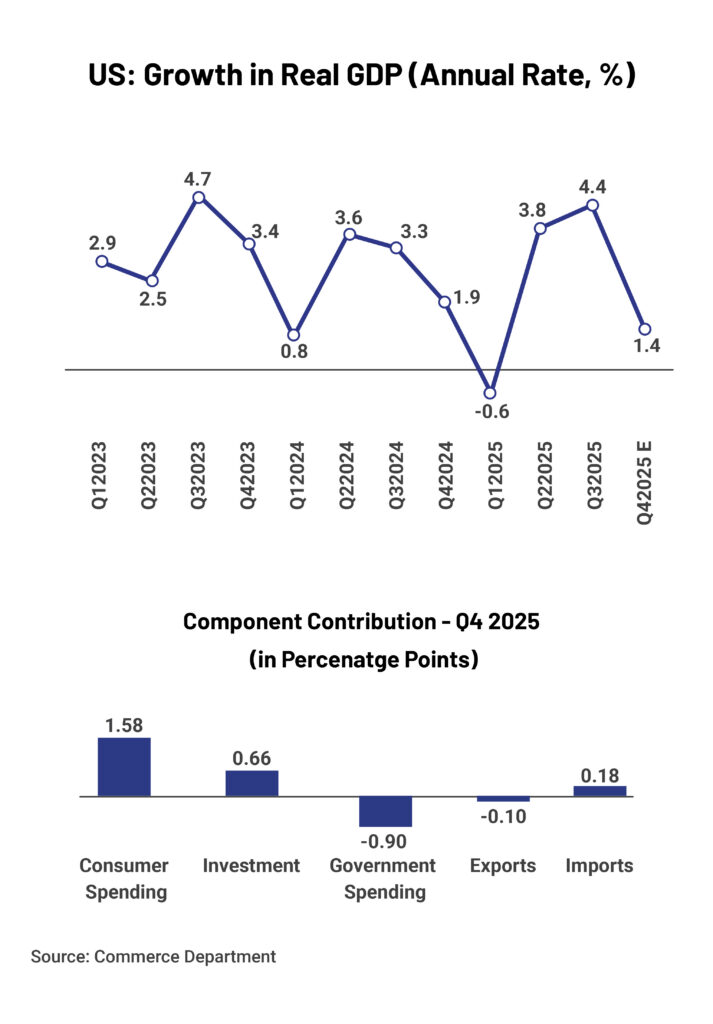
The US economy grew at an annualised rate of 1.4% QoQ (seasonally adjusted annual rate or SAAR) in Q4 2025, indicating a significant slowdown from 4.4% in Q3, as per the advance estimate released by the US Bureau of Economic Analysis. The projection was also lower than the market estimates of 3%.
The deceleration is driven by a slowdown in private consumption (contributing two-thirds to GDP) growth to 2.4% in Q4 from 3.5% in Q3. Government spending and investment also weighed on growth, falling sharply by 5.1% QoQ SAAR compared to 2.2% in the previous quarter due to the 43-day federal governments shutdown. Net exports were also a drag as exports declined 0.9% in Q4 against a pickup of 9.6% in Q3 and imports fell 1.3% in Q4 vs 4.4% in Q3.
On the other hand, fixed investments grew 2.6% QoQ SAAR in Q4 compared to 0.8% in Q3 driven by acceleration in both non-residential (3.7% vs. 3.2%) mainly AI technology and infrastructure and residential investments (-1.5% vs. -7.1%).
Considering the full year 2025, US economy grew 2.2% YoY as per advance estimates, below the market estimates of 2.4% and lower than 2.8% YoY growth in 2024. Economists expect US GDP to grow at a moderate pace in 2026 driven by an increase in government spending and business investments. However, slowdown in consumer spending and weakening consumer confidence followed by geopolitical tensions remain key downside risks.
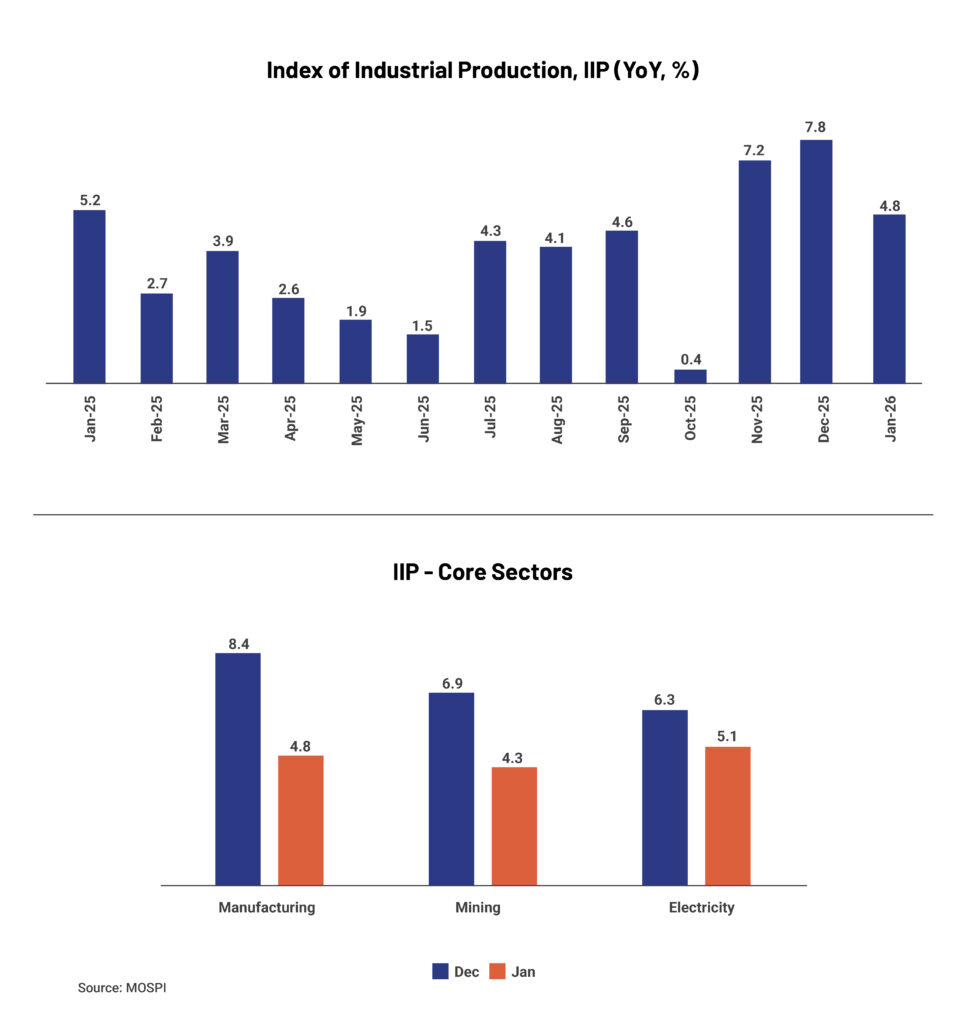
The growth in India’s industrial output, which is measured by the Index of Industrial Production (IIP), moderated to 4.8% YoY in January 2026 from over two-year high of 7.8% YoY in December. The slowdown can be attributed to subdued growth in all three core sectors in the IIP basket – manufacturing, mining, and electricity.
The growth in manufacturing sector, the largest contributor to IIP, fell sharply to a 3-month low of 4.8% YoY in January from 8.4% in December, reflecting post festive production and inventory adjustments. Within the manufacturing segment, only 8 out of 23 industry groups recorded YoY increase in January. Mining sector output declined 4.3% YoY in January from 6.9% in December. The electricity sector output also decelerated to 5.1% in January from 6.3% in December.
As per the use-based classification, 5 of 6 sub-segments witnessed a decline in output during the month under review. Output in primary goods sector slowed to 3.1% in January from 4.4% in December. Similar contraction was observed in consumer durables (6.3% vs. 12.4%), consumer non-durables (-2.7% vs. 8.5%), and intermediate goods (6% vs. 7.8%). On the other hand, infrastructure/construction goods sector recorded a double-digit growth of 13.7% YoY for the third consecutive month in January. Despite moderation in the month under review, IIP growth is expected to be stable in the near term driven by government spending on infrastructure.
Disclaimer: The information provided in this article is for general informational purposes only and is not an investment, financial, legal or tax advice. While every effort has been made to ensure the accuracy and reliability of the content, the author or publisher does not guarantee the completeness, accuracy, or timeliness of the information. Readers are advised to verify any information before making decisions based on it. The opinions expressed are solely those of the author and do not necessarily reflect the views or opinions of any organization or entity mentioned.